
The Hero’s Disease
Why a bankrupt founder would rather bleed outside the village than quietly rot inside safety.

OREDA KEN
Originally written in Japanese.
Rebuilt in English to carry the heat.
Different places — same fight.
The Gravity of the Comfort Zone
There is a concept in biology called homeostasis.
Humans are creatures that inherently despise change. We constantly try, by any means necessary, to remain exactly where we are.
The usual routine. The usual relationships. The usual job. The usual income. The usual role. The moment you try to deviate even slightly from these things, your mind and body will fight with everything they have to drag you back to where you were.
We also call this the “comfort zone.” A place that is familiar to you, a place where you feel secure. A place where you won’t get hurt, and where everything is predictable.
There is absolutely nothing wrong with staying there. In fact, for the vast majority of people in this world, I believe that is undoubtedly what constitutes “happiness.”
You work for a stable company, and a fixed salary hits your bank account every month. You live peacefully with your family, avoid massive risks, and make sure not to rock the boat. You live a “today” that is exactly the same as your “yesterday.”
There are people who are genuinely happy living that way, and I have absolutely zero intention of denying their way of life. Living quietly, living within the framework of a system (homeostasis), is not a mistake. If it brings peace to your mind, then for you, it is the absolute correct answer.
But I want to say this out loud.
There are people in this world who are physically, fundamentally incapable of doing that. There are people who simply cannot remain in that lukewarm water.
They are supposed to be stable, yet they are suffocating. They are supposed to be protected, yet their minds are dying, bit by bit. They are supposed to be in a safe place, but they can hear a scream echoing from the very bottom of their bodies.
I am not exaggerating here. This is literally a matter of life and death.
To the people around them, it probably looks like the ultimate luxury problem.
“You have a job, don’t you?” “You’re getting a paycheck, aren’t you?” “You’re protected by the company, so just live a normal life.” Everyone will tell you the exact same thing.
But what is impossible is impossible! This is not me being soft. This is not me being selfish.
There is “something” deep inside these people that rejects being domesticated within a framework at an instinctual level. It is a rejection down to the genetic code.
What I Learned Returning to Corporate Life After 12 Years
I am probably—no, definitely—that type of person.
I know this is incredibly selfish of me, but please, just listen to my agonizing scream for a moment. (lol)
Recently, I returned to being a corporate employee for the first time in 12 years. I crushed my company, filed for personal bankruptcy, and fell completely out of the framework of being a business owner. I was in a bloodbath. And now, I have crawled back inside the framework called a “company.”
Of course, from the bottom of my heart, I am grateful that they hired me, that they gave me a job and a role. I truly appreciate it.
But on an entirely different level, there is something inside my body screaming like a maniac.
“If I stay here too long, I am definitely going to break!”
“If I just try to ride this out, I am going to get violently ill!”
That is what it’s screaming.
I actually have the experience of destroying my health with a thyroid disease because I kept doing things I didn’t want to do, so I can feel the warning signs as clearly as if I were holding them in my hands.
And this time, it’s much worse. Because I spent 12 years outside the framework.
For a man who lived in the wasteland outside the walls for 12 years to suddenly fit himself back inside a pre-drawn box... it is unimaginably brutal.
When I told my parents, they said this:
“You went bankrupt. Just be a quiet employee. Don’t ask for luxuries!”
A luxury? It’s the opposite. This situation is not a luxury. It is the exact opposite.
A predetermined schedule. A predetermined atmosphere. Predetermined relationships. A predetermined evaluation system. And a predetermined role.
I am not saying those things are bad.
I genuinely respect the people who can live properly and honestly within that system.
But for my soul, it acts like a toxic poison. It just doesn’t fit. It is agonizing.
This isn’t some naive plea of, “Please treat me like I’m special.”
It’s the exact opposite. It’s about having to brutally admit to myself, “I am a defective human being who is incapable of living quietly inside homeostasis.”
The Madness That Forces You Outside
If I were to bounce this problem off an AI, it would probably respond like this:
“That is a dangerous way of thinking.”
“You must not underestimate the value of stability.”
“Do not overexert yourself; let’s find a way to adapt to your current environment.”
Yeah. It’s so correct I can’t even argue.
But that is the cold answer of a robot that understands absolutely nothing about the messy, ugly karma (Gou) of human beings.
Because within the human species, there are those who harbor a madness that forces them to leap out into the external world, no matter the cost.
There are humans who will shatter their comfort zones, tear themselves away from the massive gravitational pull of homeostasis, and plunge into the outside.
And there are humans who see sights that can only be witnessed in that external wasteland, and who return covered in scars. I believe humanity has been dragged forward by these exact outcasts.
If everyone had just sat quietly inside homeostasis, humanity would never have evolved.
Someone had to row out into the ocean. Someone had to cross the mountain. Someone had to break the village rules, doubt common sense, and step into an unknown place where they might die.
And they brought back fire they had never seen, new knowledge, new tools, new words, new worldviews. In mythology, we called these people “Heroes.”
A hero isn’t just someone with strong muscles. A hero is someone who voluntarily walks away from a safe place.
They leave the daily routine of the village, venture into the brutal world outside, engage in a death match with monsters, and even as they are dying, they grasp something and bring it back.
Sometimes that object is called an Elixir, sometimes it is called Fire, but the essence is always the same.
They bring back something that can only be obtained by someone who went outside, and they give it to the people who stayed inside. That is the role of a hero.
The Hero Sleeping Inside You
So, why have humans been so deeply moved by these hero myths for thousands of years?
This is what I think.
It is because, in truth, a “hero” is sleeping inside everyone.
Even inside a person who appears to be living the most ordinary life imaginable, there is a tiny hero somewhere inside them:
“I actually want to go outside.”
“I want to take a risk.”
“I want to shatter my own limits.”
“I don’t want to end my life like this.”
Screaming those very words.
But the wall of reality is thick. You have a family. You have a job. You have a livelihood to protect. You have societal expectations. And above all, you have the terror of failure.
Therefore, instead of going outside themselves, people overlay their own hearts onto the hero in the story and experience a pseudo-adventure.
They are deeply moved by an entity that goes to the places they cannot go, and sees the sights they cannot see. As long as the ember of a hero exists inside humans, the myth of the hero will never die.
And I believe this: The people who cannot endure homeostasis, the people who feel like they are suffocating—they are not just social misfits. Perhaps, they are the “vessel of a hero.”
It Hurts More to be Caged Than to be Destroyed
Of course, this isn’t some beautiful fairy tale.
The life of a person who steps outside the framework is, generally speaking, a violent storm.
You throw away stability. You fail. You get laughed at by society. You become isolated. You lose your money, you lose your credibility, and you lose the things that matter most to you.
I actually lost everything.
I crushed my company. I went bankrupt. My cheap vanity and my paper-thin pride were completely incinerated in the muddy hellfire.
So, I have absolutely no intention of irresponsibly saying, “If you go outside, your dreams will come true and you will be happy.” The outside world is not sweet. It is hell. If you are not prepared to be burned by hellfire, you should absolutely not do it.
But, even so.
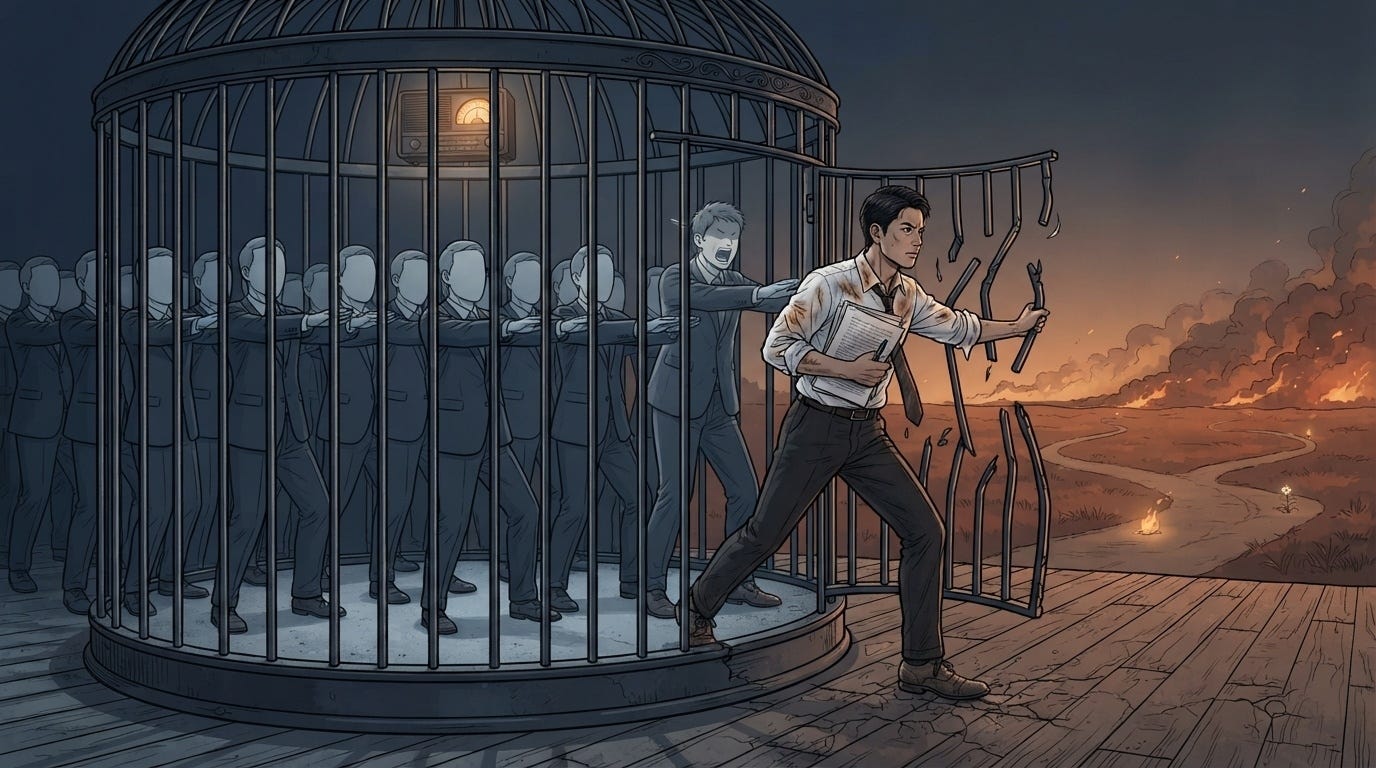
There are people who find it more painful to be caged and kept as a pet inside the prison of homeostasis than to have their lives torn apart by a storm.
There are people who find it more agonizing to be injected with the anesthesia of “stability” until they can’t breathe, people who find it far more terrifying to kill their own souls just to survive, than to fail and be covered in mud.
If that is you, then perhaps you are not just a social misfit.
Perhaps the hero inside you is simply screaming, driving you mad, demanding to be let out.
The Heroes of the 21st Century Don’t Have to Die
Of course, I am not saying you should go die like the great figures of the past just because you are a hero.
The heroes of myth, and the revolutionaries of history—people with overwhelmingly strong convictions—often met tragic ends.
But it is different now. We are in the 21st century. We have psychology. We have medicine. We have mythology. We have AI. And above all, we have the ultimate broadcasting tool: the Internet.
In the old days, the only way for the life of a hero who went outside to be known was for someone else to pass it down as a myth after they died.
But now, you can tell your own story. You can write it, and you can deliver it to the entire world. You can carve the bloodbaths you survived into history using your own words. You can take your inner Heat and forge it into your own Copy. This is an unbelievable era.
Therefore, I believe modern heroes do not need to die. You don’t need to sacrifice your life, and you don’t need to completely destroy your mind.
Rather, you go outside so that you don’t break. You step outside the framework so that you don’t kill your soul. You create your own place with your own hands so that you don’t get sick. I believe this is exactly how the heroes of the 21st century fight.
Stepping Outside Again, Armed with Heat
I went outside once. I fought as a business owner for 12 years, and I failed spectacularly. I crushed my company, filed for bankruptcy, and ran back inside the framework.
But having returned, I am certain. I cannot survive long inside this box. This is not me running away; it is a brutally honest, piercing scream from my soul.
So, I am going outside one more time.
My breath caught, and the pressure in my chest stopped feeling like panic and started feeling like resolve.
However, I will not go out the same way I did before. It is not to show off. It is not to play pretend as a CEO. It is not to make other people think I am amazing.
This time, I will step outside carrying an undeniable Heat inside me. I will step outside armed with the words I weave (Copy). And above all, I will step outside carrying the deepest Shuraba of all-a “failure” that forced me to look at hell itself.
And I want to show a path to the people who are suffering, suffocating inside homeostasis just like I was.
I am not going to irresponsibly incite you by saying, “You should get out of here right now.”
Everyone has their own life, and things they must protect. If you can feel happiness within homeostasis, you should absolutely stay there.
But there are people who simply cannot. There are people whose minds rot, bit by bit, while inside the framework. I want to speak to those people. You might not be broken. The hero inside you might just be waiting for the moment to wake up.
We only get one life. I am going to step out of line just one more time. I am terrified. Of course I am. I might fail again. I might be laughed at again. I might see a bottomless hell again.
But even so, I would rather live bleeding and scarred in the wasteland outside, than slowly, quietly get sick and rot inside the framework.
I will never deny those who live according to homeostasis. But I will also never let anyone deny the people who shatter homeostasis and step outside.
I believe the world needs both. The people who protect the village, and the people who fly out of it. Both are absolutely essential. It just so happens that I was a person meant to leave the village. That is all.
So I will push forward.
The heroes of the 21st century absolutely do not die. I believe that even as we burn in the hellfire, we will always survive and make it back.
When Homeostasis Becomes a Cage
If we analyze this not as a tragic memoir, but through the framework of Joseph Campbell’s Hero’s Journey, the mechanics become clearer.
Most business literature treats the desire to start a company as a rational calculation-a pursuit of wealth, autonomy, or market disruption. But as anyone who has actually survived the process knows, that explanation is too clean. For some people, the urge to break away from the corporate structure is not a spreadsheet decision. It is closer to a survival response.
In Campbell’s structure, the hero begins in the “Ordinary World.” It is safe. It is predictable. But for the hero, it is suffocating. They receive a “Call to Adventure”-an internal or external crisis that demands they leave the village. In the modern business context, the village is the corporate hierarchy. It is a machine designed to preserve homeostasis, predictability, and order.
The people who thrive in the village are not weak; they are the stabilizers. They maintain the baseline that lets a society function. But some people are damaged by that same stability. For them, staying inside the structure for too long begins to feel less like safety and more like slow suffocation. When they leave the corporate structure, they cross the threshold into the “Special World”-the unregulated, unforgiving reality of the market.
This is where they encounter the abyss. For me, that abyss was my own bankruptcy. It is the “Ordeal.” The village cannot help you here. You are burned down to your core.
But here is the critical business insight: You cannot extract the Elixir without facing the Ordeal.
The “Elixir” in business isn’t just money. It is the hard-won, scars-and-all truth about human nature, markets, and survival. It is the Heat. The modern tragedy is that we have sanitized this journey. We tell people they can be “heroes” by taking a weekend course or buying a SaaS product. We try to hack the Hero’s Journey without crossing the threshold.
The business lesson is not that everyone should quit and run into the wilderness. The lesson is that some kinds of suffering are not cured by better obedience. If stability is genuinely keeping you alive, stay there. But if the cage is what is making you sick, then the honest task is to build a place where you can breathe without killing your own soul. In the 21st century, you do not have to die to be a hero. But you do have to stop calling poison medicine.
Decoding “SHURABA”
1. 業火 (Gouka)
Meaning: Hellfire; the flames of karma.
Nuance: A recurring, critical term in Oreda’s vocabulary. It does not just mean a difficult situation; it refers to the purifying, destructive fire of one’s own karma, desires, and failures. To be burned by Gouka means to have your ego and illusions completely stripped away by reality.
2. 飼い殺し (Kaigoroshi)
Meaning: To be kept as a pet until death; to be paid but given no meaningful work or agency.
Nuance: A brutal critique of the modern corporate safety net. It implies that a company might provide you with food (a salary) and shelter (stability), but in exchange, it slowly kills your soul, your ambition, and your true potential. You are safe, but you are effectively dead.
3. ホメオスタシス (Homeostasis)
Meaning: Homeostasis; the tendency toward a relatively stable equilibrium.
Nuance: Oreda violently repurposes this biological term to describe the psychological and societal pressure to remain average. In his context, homeostasis is not a protective mechanism; it is an invisible cage that traps people who are wired to feel caged by too much stability.
🔓 The Raw Japanese Behind the Heat Copy
A quick note before the deep-dive section.
This section is built like paid material - the kind of deep breakdown I plan to reserve for subscribers in the future.
For now, I’m leaving it open.
Why?
Because I want serious readers to see the difference between the English Heat Copy above and the raw Japanese underneath it.
You’ve just read the reconstructed English version of my argument about homeostasis, hero myths, and why some people rot faster inside safety than they bleed outside it.
Below, you’ll see the Japanese original, followed by a sentence-by-sentence translation that stays close to the original structure.
The gap between these two versions is the actual lesson.
Study Section: 一文ごとの完全対訳
ホメオスタシスに耐えられない人へ。それは異常ではなく、英雄の器かもしれない
To Those Who Cannot Endure Homeostasis: You Are Not Abnormal, You Might Be the Vessel of a Hero
ホメオスタシスという言葉がありますよね。
There is a concept in biology called homeostasis.
恒常性のことです。
It means constancy.
人間は変化を嫌う生き物で、今いる場所に何とか留まろうとします。
Humans are creatures that inherently despise change, constantly trying by any means necessary to remain exactly where they are.
いつもの生活、いつもの人間関係、いつもの仕事、いつもの収入、そしていつもの役割。
The usual routine, the usual relationships, the usual job, the usual income, and the usual role.
そこから少しでも外れようとすると、心と身体が全力で元の場所へ引き戻そうとするわけです。
The moment you try to deviate even slightly from these things, your mind and body will fight with everything they have to drag you back to where you were.
コンフォートゾーンという言葉もありますよね。
We also call this the “comfort zone.”
自分にとって慣れた場所であり、安心できる場所。
A place that is familiar to you, a place where you feel secure.
傷つかないし、予測できる場所です。
A place where you won’t get hurt, and where everything is predictable.
そこにいること自体は、別に悪いことじゃありません。
There is absolutely nothing wrong with staying there.
むしろ、世の中の多くの人にとっては、それが間違いなく「幸せ」なんだと思います。
In fact, for the vast majority of people in this world, I believe that is undoubtedly what constitutes “happiness.”
安定した会社に勤めて、毎月決まった給料が入る。
You work for a stable company, and a fixed salary hits your bank account every month.
家族と穏やかに暮らして、大きなリスクを取らず、波風を立てない。
You live peacefully with your family, avoid massive risks, and make sure not to rock the boat.
昨日と同じ今日を生きる。
You live a “today” that is exactly the same as your “yesterday.”
それで幸せな人は確かにいるし、その生き方を否定するつもりは一切ありません。
There are people who are genuinely happy living that way, and I have absolutely zero intention of denying their way of life.
大人しく生きること、恒常性(システム)という枠の中で生きること自体は、何も間違っていない。
Living quietly, living within the framework of a system (homeostasis), is not a mistake.
それで心が穏やかになるなら、その人にとってはそれが大正解です。
If it brings peace to your mind, then for you, it is the absolute correct answer.
でも、あえて声を大にして言いたい。
But I want to say this out loud.
世の中には、それが絶対に無理な人間がいるんですね。
There are people in this world who are physically, fundamentally incapable of doing that.
どうしても、その生ぬるい場所に留まっていられない人間がいる。
There are people who simply cannot remain in that lukewarm water.
安定しているはずなのに息が詰まり、守られているはずなのに心が少しずつ死んでいく。
They are supposed to be stable, yet they are suffocating, and they are supposed to be protected, yet their minds are dying bit by bit.
安全な場所にいるはずなのに、身体の奥底から悲鳴が聞こえてくる。
They are supposed to be in a safe place, but they can hear a scream echoing from the very bottom of their bodies.
これ大袈裟に言ってませんからね。
I am not exaggerating here.
マジで死活問題。
This is literally a matter of life and death.
周りから見れば、ただの贅沢な悩みにしか見えないでしょうね。
To the people around them, it probably looks like the ultimate luxury problem.
「仕事があるじゃないか」「給料をもらっているじゃないか」「会社に守られているんだから普通に生きればいいじゃないか」と、誰もが口を揃えて言います。
Everyone says the same thing: “You have a job, don’t you?” “You’re getting a paycheck, aren’t you?” “You’re protected by the company, so just live a normal life.”
でも、無理なものは無理!
But what is impossible is impossible!
これは甘えでも、わがままでもない。
This is neither softness nor selfishness.
その人間の奥底にある「何か」が、枠の中で飼い慣らされることを本能レベルで拒絶している。
There is “something” deep inside these people that rejects being domesticated within a framework at an instinctual level.
もはや遺伝子レベルでの拒絶です。
It is a rejection down to the genetic code.
12年ぶりに会社員に戻って分かったこと
What I Learned Returning to Corporate Life After 12 Years
たぶんというか絶対、俺はそのタイプです。
I am probably—no, definitely—that type of person.
誠に勝手ですが今の僕の、この悲痛な叫びを聞いてください(笑)
I know this is incredibly selfish of me, but please, just listen to my agonizing scream for a moment. (lol)
最近、12年ぶりに会社員に戻りました。
Recently, I returned to being a corporate employee for the first time in 12 years.
会社を潰し、自己破産し、経営者という枠の外、つまり修羅場にいた人間が、もう一度「会社」という枠の中に戻ったんですね。
I crushed my company, filed for personal bankruptcy, fell outside the framework of being a business owner-into Shuraba-and then came back once more into the framework called a “company.”
もちろん、雇ってもらったことや、仕事と役割を与えられたことには心の底から感謝しています。
Of course, from the bottom of my heart, I am grateful that they hired me, that they gave me a job and a role.
それは本当にありがたい。
I truly appreciate it.
でも、それとは全く別の次元で、身体の奥で叫び狂っているものがある。
But on an entirely different level, there is something inside my body screaming like a maniac.
「ここに長くいたら、俺は確実に壊れる!」
“If I stay here too long, I am definitely going to break!”
「このままやり過ごそうとすれば、間違いなく病気になる!」
“If I just try to ride this out, I am going to get violently ill!”
と。
That is what it’s screaming.
実際にやりたくないことをやり続けて、一度甲状腺の病気で体を壊しかけた経験があるから、その予兆が手に取るように分かるんですよね。
I actually have the experience of destroying my health with a thyroid disease because I kept doing things I didn’t want to do, so I can feel the warning signs as clearly as if I were holding them in my hands.
しかも今回の方がきつい。
And this time, it’s much worse.
12年も枠の外にいたから。
Because I spent 12 years outside the framework.
枠の外の荒野に12年もいた人間が、もう一度枠の中に収まるというのは、想像を絶するほどきつい。
For a man who lived in the wasteland outside the walls for twelve years to fit himself back inside a pre-drawn box is unimaginably hard.
親に話すとこう言われました。
When I told my parents, they said this:
「破産したんだがら大人しく会社員をやってろ。贅沢言うな!」
“You went bankrupt. Just be a quiet employee. Don’t ask for luxuries!”
贅沢ですか?逆です。
A luxury? It’s the opposite.
この状況が贅沢ではない。
This situation is not a luxury.
むしろ逆。
It is the exact opposite.
決められた時間、決められた空気、決められた人間関係、決められた評価、そして決められた役割。
A predetermined schedule, a predetermined atmosphere, predetermined relationships, a predetermined evaluation system, and a predetermined role.
それが悪いと言っているわけじゃない。
I am not saying those things are bad.
そこで真っ当に生きられる人は本当にすごいと、心から尊敬しています。
I genuinely respect the people who can live properly and honestly within that system.
でも僕の魂には、それが劇薬のように合わなくて、かなりきつい。
But for my soul, it acts like a toxic poison that simply does not fit, and it is agonizing.
これは「自分を特別扱いしてほしい」という甘い話じゃありません。
This isn’t some naive plea of, “Please treat me like I’m special.”
むしろ逆で、「俺はホメオスタシスの中で静かに生きることができない、不適合な人間なのだ」と、残酷なまでに自分で認めるしかないという話です。
It is the exact opposite: it is about having to admit, with brutal honesty, that I am a misfit who cannot live quietly inside homeostasis.
人間の中にある、外に出なければならない狂気
The Madness That Forces You Outside
もしこの悩みをAIに壁打ちしたら、たぶんこう返ってくるでしょうね。
If I were to bounce this problem off an AI, it would probably respond like this:
「それは危険な考えです」
“That is a dangerous way of thinking.”
「安定を軽視してはいけません」
“You must not underestimate the value of stability.”
「無理をせず、今の環境に適応する方法を考えましょう」
“Do not overexert yourself; let’s find a way to adapt to your current environment.”
と。まあ、ぐうの音も出ないほど正しい。
Yeah-so correct I cannot even argue.
でも、それは人間のドロドロした業(ごう)というものが全く分かっていない、そんなの冷たいロボットの答え。
But that is the cold answer of a robot that understands absolutely nothing about the messy, ugly karma (Gou) of human beings.
なぜなら、人間という種族の中には、どうしても外の世界へ飛び出さなければならない狂気を抱えた奴らがいるからです。
Because within the human species, there are those who harbor a madness that forces them to leap out into the external world, no matter the cost.
コンフォートゾーンをぶち破り、ホメオスタシスの強力な引力を振り切ってでも、外の世界に出ていく人間がいる。
There are humans who will shatter their comfort zones, tear themselves away from the massive gravitational pull of homeostasis, and plunge into the outside.
そして、その外側の荒野でしか見えない景色を見て、傷だらけになって帰ってくる人間がいる。
And there are humans who see sights that can only be witnessed in that external wasteland, and who return covered in scars.
人類って、そういうはみ出し者たちによって前に進んできたんじゃないかと思うんです。
I believe humanity has been dragged forward by these exact outcasts.
みんなが恒常性の中で大人しくしていたら、人類は進化しなかったはずです。
If everyone had just sat quietly inside homeostasis, humanity would never have evolved.
誰かが海に漕ぎ出し、山を越え、村の掟を破り、常識を疑い、死ぬかもしれない未知の場所へ足を踏み入れた。
Someone had to row out into the ocean, cross the mountain, break the village rules, doubt common sense, and step into an unknown place where they might die.
そして、見たこともない火や知恵、新しい道具、新しい言葉、新しい世界観を持ち帰ってきた。
And they brought back fire they had never seen, new knowledge, new tools, new words, new worldviews.
神話の世界では、そういう人間のことを「英雄」と呼びました。
In mythology, we called these people “Heroes.”
英雄というのは、ただ腕っぷしが強い人間のことじゃない。
A hero isn’t just someone with strong muscles.
安全な場所から自ら出ていく人間のことです。
A hero is someone who voluntarily walks away from a safe place.
日常の村を離れ、外の過酷な世界へ行き、怪物と死闘を繰り広げ、死にかけながらも、最後には何かを掴んで持ち帰る。
They leave the daily routine of the village, venture into the brutal world outside, engage in a death match with monsters, and even as they are dying, they grasp something and bring it back.
その持ち帰る品はエリクサーと呼ばれたり、火と呼ばれたりしますが、本質は常に同じです。
Sometimes that object is called an Elixir, sometimes it is called Fire, but the essence is always the same.
外側に行った人間にしか手に入れられないものを、内側にいる人間たちのために持ち帰る。
They bring back something that can only be obtained by someone who went outside, and they give it to the people who stayed inside.
それが英雄の役割です。
That is the role of a hero.
誰の中にも英雄が眠っている
The Hero Sleeping Inside You
では、なぜ人は何千年も前からそういう英雄の物語に心を打たれ続けるのか。
So, why have humans been so deeply moved by these hero myths for thousands of years?
僕はこう思っています。
This is what I think.
本当は、誰の中にも「英雄」が眠っているからだと。
It is because, in truth, a “hero” is sleeping inside everyone.
どんなに平凡に生きているように見える人の中にも、どこかに小さな英雄がいて、
Even inside a person who appears to be living the most ordinary life imaginable, there is a tiny hero somewhere inside them:
「本当は外に出たい」
“I actually want to go outside.”
「挑戦したい」
“I want to take a risk.”
「自分の限界を超えたい」
“I want to shatter my own limits.”
「このまま終わりたくない」
“I don’t want to end my life like this.”
と叫んでいる。
Screaming those very words.
でも、現実の壁は厚い。
But the wall of reality is thick.
家族がいる、仕事がある、生活がかかっている、世間体がある、そして何より失敗への恐怖がある。
You have a family, a job, a livelihood to protect, social expectations, and above all the terror of failure.
だから人は、自ら外に出る代わりに、物語の中の英雄に自分の心を重ねて擬似英雄体験をするんです。
Therefore, instead of going outside themselves, people overlay their own hearts onto the hero in the story and experience a pseudo-adventure.
自分の代わりに行けない場所へ行き、見られない景色を見てきてくれる存在に、強く心を動かされる。
They are deeply moved by an entity that goes to the places they cannot go, and sees the sights they cannot see.
人の中に英雄の火種がある限り、英雄の物語は消えないんです。
As long as the ember of a hero exists inside humans, the myth of the hero will never die.
そして俺は思うんです。
And I believe this:
ホメオスタシスに耐えられず、息苦しさを感じている人間は、単なる社会不適合者なんかじゃない。
The people who cannot endure homeostasis, the people who feel like they are suffocating—they are not just social misfits.
もしかすると、それは「英雄の器」なのかもしれないと。
Perhaps, they are the “vessel of a hero.”
荒れることより、飼われることの方が辛い人間
It Hurts More to Be Caged Than to Be Destroyed
もちろん、これは耳障りのいい綺麗事じゃないですよ。
Of course, this isn’t some beautiful fairy tale.
枠をはみ出す人間の人生は、だいたいにおいて荒れ狂いますから。
The life of a person who steps outside the framework is, generally speaking, a violent storm.
安定を捨て、失敗し、世間から笑われ、孤独になり、金を失い、信用を失い、大切なものまで失っていく。
You throw away stability, fail, get laughed at by society, become isolated, lose your money, lose your credibility, and even lose the things that matter most to you.
まさかの僕は実際にすべてを失いました。
I actually lost everything.
会社を潰し、自己破産し、安い見栄も薄っぺらいプライドも、すべてドロドロの業火で焼き尽くされた。
I crushed my company, went bankrupt, and had my cheap vanity and paper-thin pride burned away in the muddy hellfire.
だから、外に出れば夢が叶って幸せになれるなんて、無責任に軽く言うつもりはありません。
So, I have absolutely no intention of irresponsibly saying, “If you go outside, your dreams will come true and you will be happy.”
外の世界は甘くないし、むしろ地獄です。
The outside world is not sweet; it is hell.
業火に焼かれる覚悟がない人は絶対にやめた方がいい。
If you are not prepared to be burned by hellfire, you should absolutely not do it.
でも、それでもです。
But, even so.
人生が荒れ狂うことよりも、恒常性という檻の中で飼い殺しにされることの方が辛い人間がいる。
There are people who find it more painful to be caged and kept as a pet inside the prison of homeostasis than to have their lives torn apart by a storm.
安定という麻酔を打たれて息ができなくなることの方が苦しいし、失敗して泥を被ることよりも、自分自身の魂を殺して生きることの方が、何倍も怖い人間がいるんです。
There are people who find it more agonizing to be injected with the anesthesia of “stability” until they can’t breathe, people who find it far more terrifying to kill their own souls just to survive, than to fail and be covered in mud.
もしあなたがそうなら、もしかすると、あなたはただの社会不適合者ではないのかもしれない。
If that is you, then perhaps you are not just a social misfit.
自分の中にいる英雄が、外へ出せと狂おしく叫んでいるだけなのかもしれない。
Perhaps the hero inside you is simply screaming, driving you mad, demanding to be let out.
21世紀の英雄は、死ななくていい
The Heroes of the 21st Century Don’t Have to Die
もちろん、英雄だから昔の偉人みたいに命を落とせと言っているわけじゃありません。
Of course, I am not saying you should go die like the great figures of the past just because you are a hero.
神話の英雄も、歴史上の革命家たちも、強い信念を持った人間は悲劇的な結末を迎えることが多かった。
The heroes of myth, and the revolutionaries of history—people with overwhelmingly strong convictions—often met tragic ends.
でも、今は違います。
But it is different now.
今は21世紀です。
We are in the 21st century.
心理学があり、医学があり、神話学があり、AIがあり、そして何よりインターネットという最強の発信手段がある。
We have psychology, medicine, mythology, AI, and above all the Internet-the ultimate means of broadcasting.
昔なら、外に出た英雄の生き様は、死んだ後に誰かが神話として語り継ぐしかなかった。
In the old days, the only way for the life of a hero who went outside to be known was for someone else to pass it down as a myth after they died.
でも今は、自分の物語を自分で語り、書き、世界中に届けられる。
But now, you can tell your own story, write it, and deliver it to the entire world.
自分のくぐり抜けてきた修羅場を、自分の言葉で刻み込める。
You can carve the bloodbaths you survived into history using your own words.
自分の内なる熱(Heat)を、自分でコピー(Copy)できる。
You can take your inner Heat and forge it into your own Copy.
これは、とんでもない時代。
This is an unbelievable era.
だから俺は、現代の英雄は死ぬ必要なんてないと思っています。
Therefore, I believe modern heroes do not need to die.
命を犠牲にする必要も、精神を完全に壊す必要もない。
You don’t need to sacrifice your life, and you don’t need to completely destroy your mind.
むしろ、自分自身が壊れないために外に出る。
Rather, you go outside so that you don’t break.
自分の魂を殺さないために、枠をはみ出す。
You step outside the framework so that you don’t kill your soul.
病気にならないために、自分の手で新しく自分の居場所を創り出す。
You create your own place with your own hands so that you don’t get sick.
これこそが、21世紀の英雄の戦い方ではないかと思うんです。
I believe this is exactly how the heroes of the 21st century fight.
もう一度、自分の熱(Heat)を持って外へ出る
Stepping Outside Again, Armed with Heat
僕は一度、外に出ました。
I went outside once.
12年間、経営者として戦い抜き、そして派手に失敗しました。
I fought as a business owner for 12 years, and I failed spectacularly.
会社を潰し、自己破産し、一度は枠の中へ逃げ戻りました。
I crushed my company, filed for bankruptcy, and ran back inside the framework.
でも、戻ってみて確信したんです。
But having returned, I am certain.
やっぱり僕は、この枠の中では長く生きられない。
I cannot survive long inside this box.
これは逃げではなく、あまりにも痛切で正直な、魂の叫びです。
This is not me running away; it is a brutally honest, piercing scream from my soul.
だから俺は、もう一度外に出る。
So, I am going outside one more time, and my breath catches as the pressure in my chest stops feeling like panic and starts feeling like resolve.
[Note: Original Japanese is briefer. Body detail added to preserve Show, don’t tell.]
ただし、前と同じようには出ません。
However, I will not go out the same way I did before.
見栄を張るためでも、社長ごっこをするためでも、他人にすごいと思われたいからでもない。
It is not to show off, to play pretend as a CEO, or to make other people think I am amazing.
今度は、自分の中にある確かな熱(Heat)を持って出る。
This time, I will step outside carrying an undeniable Heat inside me.
自分の紡ぐ言葉(Copy)を持って出る。
I will step outside armed with the words I weave (Copy).
そして何より、地獄を見た「失敗」という最強の修羅場を持って出ます。
And above all, I will step outside carrying the ultimate bloodbath—a “failure” that forced me to look at hell itself.
そして、僕と同じようにホメオスタシスの中で息ができなくなって苦しんでいる人たちに、ひとつの道を示したい。
And I want to show a path to the people who are suffering, suffocating inside homeostasis just like I was.
「あなたも今すぐここから出ろ」
“You should get out of here right now.”
なんて、無責任に煽るつもりはありません。
I am not going to irresponsibly incite you by saying that.
人にはそれぞれの生活があり、守るべきものがある。
Everyone has their own life, and things they must protect.
恒常性の中で幸せを感じられるなら、絶対にそこにいた方がいい。
If you can feel happiness within homeostasis, you should absolutely stay there.
でも、どうしても無理な人がいる。
But there are people who simply cannot.
枠の中にいると、少しずつ心が腐っていく人がいる。
There are people whose minds rot, bit by bit, while inside the framework.
そういう人に伝えたいんです。
I want to speak to those people.
あなたは壊れているのではないかもしれない。
You might not be broken.
あなたの中の英雄が、目覚めの時を待っているだけかもしれないと。
The hero inside you might just be waiting for the moment to wake up.
一度きりの人生です。
We only get one life.
俺は、もう一度だけはみ出してみます。
I am going to step out of line just one more time.
怖いです。
I am terrified.
当然怖い。
Of course I am.
また失敗するかもしれないし、笑われるかもしれないし、底なしの地獄を見るかもしれない。
I might fail again, be laughed at again, and see a bottomless hell again.
でも、それでも僕は、枠の中で少しずつ静かに病んで腐っていくくらいなら、外の荒野で血を流し、傷つきながら生きる方を選びたい。
But even so, I would rather live bleeding and scarred in the wasteland outside, than slowly, quietly get sick and rot inside the framework.
ホメオスタシスに従って生きる人を否定はしない。
I will never deny those who live according to homeostasis.
でも、ホメオスタシスをぶち破って外に出る人間も、誰にも否定させない。
But I will also never let anyone deny the people who shatter homeostasis and step outside.
世界には、その両方が必要なんだと思います。
I believe the world needs both.
村を守る人間と、村を飛び出す人間。
The people who protect the village, and the people who fly out of it.
どちらも絶対に欠かせない。
Both are absolutely essential.
ただ、俺は村を出る側の人間だった。
It just so happens that I was a person meant to leave the village.
たったそれだけの話です。
That is all.
だから僕は、突き進みます。
So I will push forward.
21世紀の英雄は、絶対に死なない。
The heroes of the 21st century absolutely do not die.
業火に焼かれながらも、必ず生きて帰って来れると信じて。
I believe that even as we burn in the hellfire, we will always survive and make it back.
Advanced Grammar & Slang Breakdown
1. 壁打ち (Kabeuchi)
Meaning: Literally “wall-hitting”—bouncing an idea off a wall to hear it come back, i.e. using someone (or something) as a sounding board.
Nuance: Originally sports slang (practicing tennis or baseball swings against a wall). In business Japanese it’s the standard word for talking through a problem with a mentor, colleague, or now an AI, not to get an answer handed to you, but to hear your own thinking bounce back. Oreda uses it here specifically to set up why an AI’s “correct” answer still feels hollow to him.
2. 生ぬるい (Namanurui)
Meaning: Lukewarm; tepid.
Nuance: Usually used for water, tea, or beer that’s neither hot nor cold enough—unsatisfying either way. Applied to a way of life, it’s a sharp insult: not comfortable enough to relax into, not intense enough to feel alive in. Oreda uses it to reject the idea that the comfort zone is actually comfortable for people like him.
3. ぶち破る (Buchi-yaburu)
Meaning: To violently smash through; to break something apart by force.
Nuance: The prefix buchi- is a rough, colloquial intensifier (think “smash” vs. “break”) almost exclusively used in spoken, aggressive contexts. Oreda pairs it with “comfort zone” and “homeostasis” to make clear this isn’t a gentle stepping-out; it’s a forceful rupture.
4. はみ出し者 (Hamidashimono)
Meaning: An outcast; someone who sticks out from or doesn’t fit the group.
Nuance: Derived from hamidasu (to protrude, to spill over the edge). In a culture that prizes conformity, this word normally carries a negative, “problem person” connotation. Oreda deliberately reclaims it as a badge of honor, arguing these are the people who drag humanity forward.
5. 社長ごっこ (Shacho-gokko)
Meaning: Playing at being a president; CEO pretend-play.
Nuance: The suffix -gokko means “playing make-believe” (like o-mama-goto, playing house). Oreda uses this as harsh self-criticism, admitting that some of what looked like entrepreneurship the first time around was really just performing the role rather than doing the work.
Author’s Note
Thank you for reading this far.
Writing this piece was a way for me to confront the terror of leaving the safety of my new corporate job. It is terrifying to step back into the wasteland after losing a company and filing for bankruptcy. The corporate world offered me homeostasis. It offered me a cage where I would not starve. But I have come to realize that for some of us, the cage becomes more dangerous than the wasteland.
I am stepping out of the village again. This time, I am armed not with empty pride, but with the undeniable Heat of my failures and the Copy to forge it. I am also fighting to master English from scratch. I use AI not to invent my thoughts, but to carry the heat of my Japanese into English without cooling it down.
If you are suffocating inside your own comfort zone, or if you feel the “hero” inside you screaming to be let out, tell me in the comments. We do not have to die to be heroes anymore. But we do have to stop lying about what is killing us.