
The Copywriting Illusion: You Cannot Fake a Scar
What a rookie salesman, a boss with a feminine presence, and bankruptcy taught me about the persuasive power no framework can manufacture.

OREDA KEN

Originally written in Japanese.
Rebuilt in English to carry the heat.
Different places — same fight.
The Authority People See Before a Word Is Spoken
There is a long-standing pattern in the Japanese entertainment industry: male entertainers with a distinctly feminine presence often attract a unique, intense kind of support. People like Matsuko Deluxe or Akihiro Miwa are prime examples.
I’m not trying to lump them all together, of course. Everyone has a different background, a different way of surviving. But there has long been an atmosphere in Japan that senses a peculiar charisma in these individuals.
It’s different from the excitement surrounding a pop idol. It’s a gravity that makes people think, “I have to listen to what this person says.” A feeling that “there is something profound inside them.”
Years ago, when I was selling real estate, I witnessed this exact power on the front lines of sales.
Back then, my direct boss was a salesman with a very distinctly feminine aura.
When he took notes during a consultation, his pinky finger would elegantly extend. He sat with his legs angled neatly to the side, a posture typically associated with women in Japan. His tone of voice was exceptionally soft, his gestures undeniably delicate.
Honestly? At first, I was taken aback.
But it wasn’t just me. The clients were surprised, too.
I remember one instance vividly. After my boss had momentarily stepped away from the table, a client leaned in, looked at me with an incredibly serious expression, and asked:
“Oreda-san, tell me the truth. Is your boss... you know?”
I had no answer to give. How could I? I had no idea myself. But looking back, I realize that wasn’t the point at all.
The point was that this client trusted my boss completely.
I was a rookie. I couldn’t handle the pitch, the presentation, or the closing. I couldn’t do a damn thing. My boss handled absolutely everything.
To be brutally honest, I was nothing but goldfish poop, trailing uselessly behind him. I just sat there.
Yet, we got the contract.
And at the very end, the client turned to me and said:
“Oreda-kun. Thank you for introducing me to such a wonderful boss.”
They weren’t looking at me. Not for a second.
Their eyes were fixed entirely on him.
At the time, I couldn’t comprehend why he was trusted so implicitly. But now, I think I’m beginning to understand.
In Japan, Being a Minority is a Story in Itself
Japan is a country where the nail that sticks out gets hammered down. It worships the average. It demands that you “read the air” (sense the unspoken rules). If you do something different, you are immediately isolated.
Times are changing, sure. But the crushing pressure of conformity still suffocates Japanese society.
When people see a man with a feminine aura living openly and proudly in this environment, their minds unconsciously begin to read a story.
This person must have walked a very difficult path.
He must have been mocked. He must have been hurt.
And yet, he wasn’t crushed. He made it this far.
Of course, this is just arbitrary imagination on the part of the observer. How he actually lived his life is a truth known only to him.
But the moment humans look at someone, we instinctively project a narrative onto them.
Has this person suffered? Does this person know what hell looks like? Is there something deeper beneath the surface?
The moment people feel that, their guards drop.
Whether in sales or copywriting, there is a sequence to how humans come to trust someone.
Sympathy. Empathy. Admiration.
I feel bad for them. But they are fighting hard. I want to support them.
Once readers or clients enter this current, they begin to truly listen to the person’s words.
I believe this is one of the core reasons why feminine men often garner such deep support in Japan.
It’s not their specific attributes that “sell.”
It’s the weight of the life the observer imagines behind them. And in that assumption, a persuasive power is born before a single word is spoken.
During my sales days, a legendary “super salesman” once told me:
“Feminine salesmen can sell.”
I didn’t understand what he meant then.
I understand it now.
It’s not a technique. It’s not the tone of voice. It’s not the gestures. It is because, lingering right behind them, there is the scent of a Shuraba—a battlefield.
The Limits of Copywriting
I am a copywriter.
Because of that, I have studied countless frameworks for writing.
The laws of mythology. The Hero’s Journey. The narrative of crossing the line of death and returning with the elixir. The method of speaking as the one who drank the muddy water so the reader wouldn’t have to.
Yes, structurally, these frameworks are correct.
People believe the words of those who have suffered. The words of someone who has stared into hell carry weight. The words of someone who survived a Shuraba—a crucible—carry persuasive power.
But there is a fatal problem.
You cannot use words to stage a hell you haven’t actually survived.
That is a lie.
Handled poorly, it’s fraud.
And readers are surprisingly perceptive. They notice.
“This guy is saying the right things, but his words feel thin.”
“It’s beautifully written, but there are no scars.”
“These aren’t the words of someone who actually suffered.”
People think they are only reading the text, but they are actually scanning the entirety of the writer’s existence.
When the words and the aura are misaligned, you can tell. Even if the writing is technically perfect, if there is no living pain inside it, it reeks of falsehood.
This is the limit of copywriting.
A person who hasn’t survived a Shuraba cannot write about one.
Frameworks alone do not move people. Techniques alone do not forge trust.
I believe this is exactly why I, as a rookie, could never beat my feminine boss.
Before he even spoke, he had authority.
“This is a man who has survived something.”
He gave off that impression.
You cannot acquire that by reading a book. You cannot buy it at a seminar. You cannot synthesize it by mastering copywriting formulas.
It is a presence that can come only from a life actually lived.
I Ended Up Crossing the Line of Death, Too
I used to think I had survived my own share of hells.
My fiancée left me. My father’s company was on the verge of collapse, and I had to rebuild it. I shouldered a debt of 20 million yen.
I thought I had paid my dues in suffering.
Looking back, I was so damn naive.
This time, I—
My company went bankrupt.
I filed for personal bankruptcy.
That’s what happened to me.
This was undeniable, absolute hell.
Status, pride, money—everything evaporates. You become a literal nobody. And yet, you still have to wake up and keep living.
Society’s gaze toward someone who has gone bankrupt is unforgiving. Especially in Japan.
In a society that worships the average, a bankrupt person becomes an unmistakable minority.
A failure. A man who lost his credibility. Someone who fell off the tracks of society.
That is how they see you. It is agonizing.
But there are things you only understand once you hit rock bottom.
I suddenly remembered why my old boss was trusted. Why men with feminine auras can possess such a unique, unshakeable persuasive power.
It is because they look like they have truly survived the fire. And the words of someone who has survived the fire carry physical weight.
You cannot manufacture this with copy. You cannot reach this with staging. Even past achievements aren’t enough.
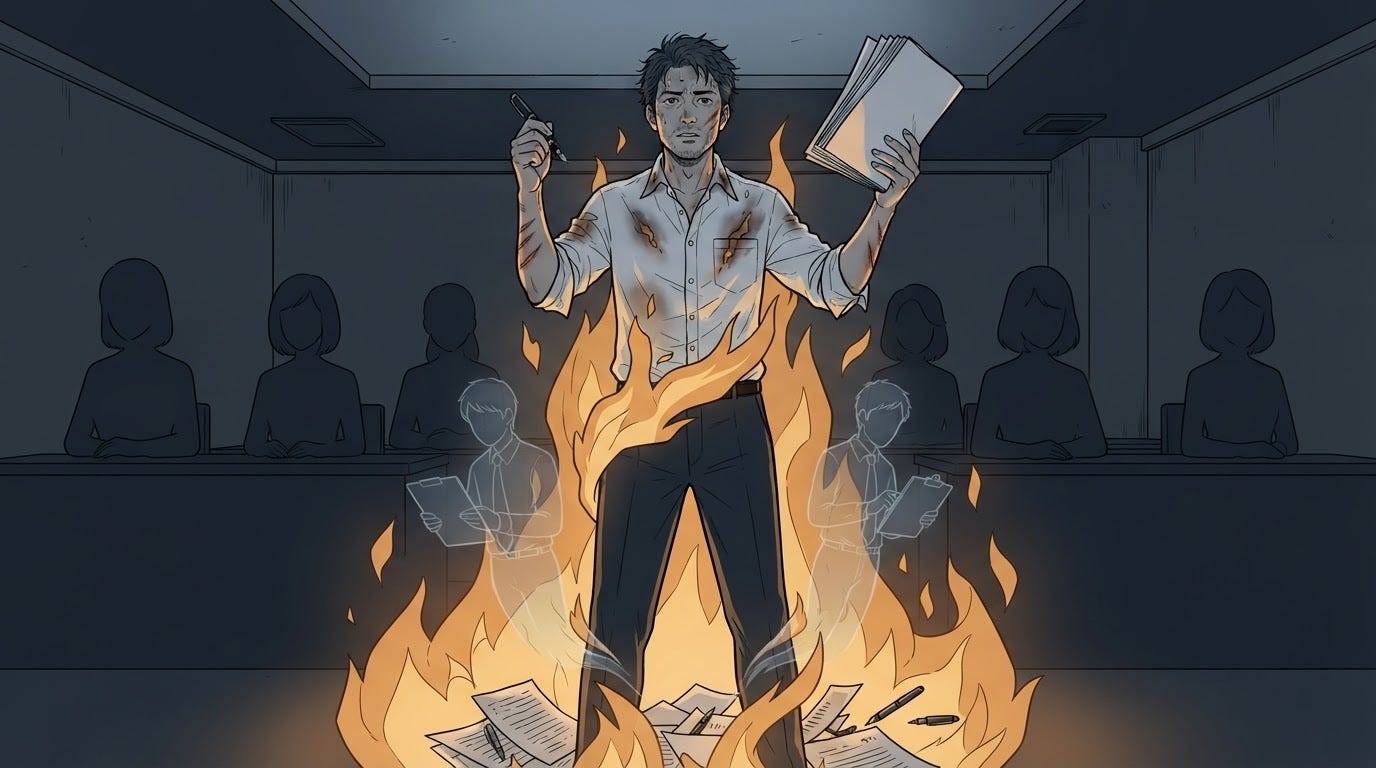
It comes down to whether or not you have been burned.
Right now, I am standing directly in the center of those flames.
I ran my company into the ground. I filed for personal bankruptcy. I returned to corporate employment. My pride and status burned to ash.
My throat tightened. Then the shame I had been swallowing began to feel like heat.
If this hell was the price I had to pay to finally acquire words that are real...
If this Shuraba was the only way to learn what true copywriting actually is...
Then it wasn’t a bad trade.
Sometimes, I genuinely believe that.
People do not trust beautiful words. They trust what you have survived.
A person who has lived as a minority. A person who has bathed in the cold stares of society. A person who lost everything but is still standing.
Their words carry a reality that no staging can replicate.
You can build trust with copywriting. You can move hearts with stories.
But in the end, what wins is what is real.
The words of a man who crossed the line of death are strong.
I am still inside the inferno.
And that is exactly why I want to take what I find in these flames, forge it into words, and deliver it.
I will hand you what remains after being burned by the Heat.
Well, then.
The Insight: The “Hero’s Journey” Cannot Be Hacked
Copywriting can give a story structure. It can show us how someone crosses a threshold, enters the abyss, and returns with something worth carrying back.
But structure cannot manufacture the life behind the story.
Readers do not only read the words. They read the distance between the words and the person speaking them. If the pain is staged, if the scars exist only because a framework demanded them, something feels wrong—even when every sentence is polished.
That does not mean suffering automatically makes someone trustworthy. Nor does it mean we can know what another person has survived by looking at them.
The clients in my story projected a life onto my boss. His feminine presence made them imagine that he had endured ridicule, isolation, or hardship. Whether that story matched his actual life was something only he knew. The important point is that the story they perceived gave his words weight before he even began to speak.
A framework can shape a story. It cannot create the existence behind it. That is the line copywriting cannot cross.
Decoding “SHURABA”
1. 出る杭は打たれる (Deru kui wa utareru)
Meaning: “The nail that sticks out gets hammered down.”
Nuance: This proverb describes the social pressure placed on people who stand out or deviate from the norm. In this essay, observers may imagine that someone visibly different has endured that pressure. The point is the story people project—not proof of what that person has actually experienced.
2. 金魚のフン (Kingyo no fun)
Meaning: “Goldfish poop.”
Nuance: A highly derogatory but common slang term for a subordinate or follower who just trails pointlessly behind a powerful person, contributing absolutely nothing. Oreda uses this severe self-deprecation to highlight just how useless he was as a rookie compared to the quiet, overwhelming authority of his boss.
3. 修羅場 (Shuraba)
Meaning: A scene of carnage; a bloodbath; a desperate situation.
Nuance: Originating from Buddhist mythology (the realm of the Asuras, demigods obsessed with war), it describes a situation of extreme, chaotic hardship. In Oreda’s context, a Shuraba isn’t just a difficult day at the office; it’s a crucible that strips away your illusions and forces you to confront survival. You cannot fake the aura of someone who has walked through a Shuraba.
🔓 The Raw Japanese Behind the Heat Copy
A quick note before the deep-dive section.
This section is built like paid material—the kind of deep breakdown I plan to reserve for subscribers in the future.
For now, I’m leaving it open.
Why?
Because I want serious readers to see the difference between the English Heat Copy above and the raw Japanese underneath it.
You’ve just read the reconstructed English version of my story about a salesman whose presence carried more weight than any script—and why lived experience gives words a persuasive force that copywriting alone cannot manufacture.
Below, you’ll see the Japanese original, followed by a sentence-by-sentence translation that stays close to the original structure.
The gap between these two versions is the actual lesson.
Study Section: 一文ごとの完全対訳
コピーでは作れない説得力
The Persuasive Power That Copy Cannot Create
修羅場をくぐった人間の言葉は、なぜ強いのか
Why Are the Words of Someone Who Survived a Shuraba So Powerful?
日本の芸能界には、女性的な雰囲気を持つ男性タレントが、独特の支持を得る流れがあります。
There is a long-standing pattern in the Japanese entertainment industry in which male entertainers with a distinctly feminine presence attract a unique kind of support.
マツコ・デラックスさんや、美輪明宏さんのような存在です。
People like Matsuko Deluxe or Akihiro Miwa are prime examples.
もちろん、一括りにするつもりはありません。
I’m not trying to lump them all together, of course.
人それぞれ背景も違うし、生き方も違う。
Everyone has a different background, a different way of surviving.
ただ、日本には昔から、そういう存在に対して独特のカリスマ性を感じる空気があると思うんです。
But there has long been an atmosphere in Japan that senses a peculiar charisma in these individuals.
キャーキャー騒がれる人気というより、「あの人の言葉なら聞いてしまう」「あの人には何かある」と感じさせるような力です。
It is not idol-style excitement, but a gravity that makes people think, “I have to listen to this person; there is something profound inside them.”
僕はこれを、昔、住宅営業の現場でも見たことがあります。
Years ago, when I was selling real estate, I witnessed this exact power on the front lines of sales.
住宅営業をしていた頃、直属の上司にかなり女性的な雰囲気を持つ営業マンがいました。
Back then, my direct boss was a salesman with a very distinctly feminine aura.
接客中に小指を立てて文字を書く。
When he took notes during a consultation, his pinky finger would elegantly extend.
座り方も、いわゆる女の子座り。
He sat with his legs angled neatly to the side, a posture typically associated with women in Japan.
口調も柔らかく、仕草もかなり女性的でした。
His tone of voice was exceptionally soft, his gestures undeniably delicate.
正直、最初は僕も驚きました。
Honestly? At first, I was taken aback.
僕だけじゃありません。
But it wasn’t just me.
お客さんも驚いていました。
The clients were surprised, too.
その上司が席を外したあと、お客さんがものすごく真剣な顔で、僕にこう聞いてきたことがあります。
I remember one instance vividly. After my boss had momentarily stepped away from the table, a client leaned in, looked at me with an incredibly serious expression, and asked:
「折田さん、正直に言ってください。あなたの上司は……そういう方なんですか?」
“Oreda-san, tell me the truth. Is your boss... you know?”
僕は答えようがありませんでした。
I had no answer to give.
そんなことは僕にも分からないからです。
How could I? I had no idea myself.
でも、大事なのはそこじゃないんですよね。
But looking back, I realize that wasn’t the point at all.
そのお客さんは、その上司を完全に信頼していたんです。
The point was that this client trusted my boss completely.
僕は新人でした。
I was a rookie.
接客も説明もクロージングも、ほとんど何もできない。
I couldn’t handle the pitch, the presentation, or the closing—I couldn’t do a damn thing.
全部、その上司がやってくれていました。
My boss handled absolutely everything.
僕は正直、金魚のフンです。
To be brutally honest, I was nothing but goldfish poop, trailing uselessly behind him.
ただ横にいただけ。
I just sat there.
それでも契約は取れました。
Yet, we got the contract.
そして最後にお客さんは、僕にこう言いました。
And at the very end, the client turned to me and said:
「折田くん、本当に良い上司を紹介してくれたね」
“Oreda-kun. Thank you for introducing me to such a wonderful boss.”
僕ではないんです。
They weren’t looking at me—not for a second.
完全に上司を見ていた。
Their eyes were fixed entirely on him.
その時は、なぜその上司があれほど信頼されるのか、僕にはよく分かりませんでした。
At the time, I couldn’t comprehend why he was trusted so implicitly.
でも今なら、少し分かる気がします。
But now, I think I’m beginning to understand.
日本では、マイノリティであること自体が物語になる
In Japan, Being a Minority Is a Story in Itself
日本は、出る杭が打たれる国です。
Japan is a country where the nail that sticks out gets hammered down.
平均を好む。
It worships the average.
空気を読むことを求められる。
It demands that you “read the air” (sense the unspoken rules).
人と違うことをすると、すぐに浮く。
If you do something different, you are immediately isolated.
もちろん時代は変わってきています。
Times are changing, sure.
それでも、日本社会にはまだ強い同調圧力があります。
But the crushing pressure of conformity still suffocates Japanese society.
その中で、女性的な雰囲気を持つ男性が堂々と生きている。
A man with a feminine aura is living openly and proudly within it.
それを見た時、人は無意識に物語を読むんだと思います。
When people see that, I think they unconsciously read a story into him.
この人は、きっと生きづらい場面をくぐってきたんじゃないか。
This person must have walked a very difficult path.
からかわれたことも、傷ついたこともあったんじゃないか。
He must have been mocked and hurt.
それでも潰れずに、ここまで来た人なんじゃないか。
And yet, he must have made it this far without being crushed.
もちろん、これは受け手側の勝手な想像です。
Of course, this is just arbitrary imagination on the part of the observer.
本人が実際にどう生きてきたかは、その人にしか分かりません。
How he actually lived his life is a truth known only to him.
でも、人は相手を見た瞬間に、勝手に物語を読み取ります。
But the moment humans look at someone, we instinctively project a narrative onto them.
この人は苦労してきたのではないか。
Has this person suffered?
この人は修羅場を知っているのではないか。
Does this person know what hell looks like?
この人は表面だけの人間ではないのではないか。
Is there something deeper beneath the surface?
そう感じた瞬間、人はガードを下げるんです。
The moment people feel that, their guards drop.
営業でもコピーライティングでも、人が誰かを信頼する時には流れがあります。
Whether in sales or copywriting, there is a sequence to how humans come to trust someone.
同情。
Sympathy.
共感。
Empathy.
憧れ。
Admiration.
かわいそう。
I feel bad for them.
でも頑張っている。
But they are fighting hard.
応援したい。
I want to support them.
この流れに入ると、人はその人の言葉を聞き始めます。
Once readers or clients enter this current, they begin to truly listen to the person’s words.
女性的な男性が日本で支持されやすい理由の一つは、ここにあると思っています。
I believe this is one of the core reasons why feminine men often garner such deep support in Japan.
その人の属性そのものが売れるのではありません。
It’s not their specific attributes that “sell.”
その人が背負ってきたであろう背景を、周囲が勝手に感じ取る。
The people around them imagine the weight of the life they must have carried.
そしてそこに、言葉以前の説得力が生まれる。
And in that assumption, a persuasive power is born that transcends mere words.
僕の営業時代、あるスーパーセールスマンがこう言っていました。
During my sales days, a legendary “super salesman” once told me:
「女性らしい営業マンは売れる」
“Feminine salesmen can sell.”
当時は意味が分かりませんでした。
I didn’t understand what he meant then.
でも今なら分かります。
I understand it now.
それはテクニックではない。
It’s not a technique.
声のトーンでもない。
It’s not the tone of voice.
仕草でもない。
It’s not the gestures.
その人の背後に、修羅場の匂いがあるからです。
It is because, lingering right behind them, there is the scent of a Shuraba—a battlefield.
コピーライティングには限界がある
The Limits of Copywriting
僕はコピーライターです。
I am a copywriter.
だから、これまでいろいろなライティングの型を学んできました。
Because of that, I have studied countless frameworks for writing.
神話の法則。
The laws of mythology.
ヒーローズジャーニー。
The Hero’s Journey.
死線をくぐり、報酬を持ち帰る物語。
The narrative of crossing the line of death and returning with the elixir.
読者の代わりに泥水を飲んできた存在として語る方法。
The method of speaking as the one who drank the muddy water so the reader wouldn’t have to.
たしかに、型としては正しい。
Yes, structurally, these frameworks are correct.
人は、苦労してきた人の言葉を信じます。
People believe the words of those who have suffered.
地獄を見てきた人の言葉には重みがあります。
The words of someone who has stared into hell carry weight.
修羅場を抜けた人の言葉には、説得力があります。
The words of someone who survived a Shuraba carry persuasive power.
でも問題があります。
But there is a fatal problem.
本当にくぐっていない修羅場を、文章で演出してはいけない。
You cannot use words to stage a hell you haven’t actually survived.
それは嘘です。
That is a lie.
下手をすれば詐欺です。
Handled poorly, it’s fraud.
しかも、読者は意外と気づきます。
And surprisingly, readers notice.
「なんかこの人、言っていることは正しいけど薄いな」
“This guy is saying the right things, but his words feel thin.”
「綺麗に書いているけど、傷がないな」
“It’s beautifully written, but there are no scars.”
「本当に苦しんだ人の言葉じゃないな」
“These aren’t the words of someone who actually suffered.”
人は、文章だけを読んでいるようで、実はその人の存在ごと見ています。
People think they are only reading the text, but they are actually scanning the entirety of the writer’s existence.
言葉とオーラがズレていると、わかる。
When the words and the aura are misaligned, you can tell.
文章だけが上手くても、そこに生きた痛みがないと、どこか嘘っぽくなる。
Even if the writing is technically perfect, if there is no living pain inside it, it reeks of falsehood.
これがコピーライティングの限界です。
This is the limit of copywriting.
修羅場をくぐっていない人が、修羅場を語ることはできない。
A person who hasn’t survived a bloodbath cannot write about one.
型だけでは、人は動かない。
Frameworks alone do not move people.
テクニックだけでは、信頼は生まれない。
Techniques alone do not forge trust.
僕が営業時代、女性的な雰囲気を持つ上司に勝てなかった理由もここにあると思います。
I believe this is exactly why I, as a rookie, could never beat my feminine boss.
その人には、言葉の前に説得力があった。
Before he even spoke, he had authority.
「この人は何かをくぐってきた人だ」
“This is a man who has survived something.”
そう感じさせるものがあった。
He gave off that impression.
それは本を読んだだけでは身につかない。
You cannot acquire that by reading a book.
セミナーに行っただけでは手に入らない。
You cannot buy it at a seminar.
コピーの型を学んだだけでは出せない。
You cannot synthesize it by mastering copywriting formulas.
生きてきた人間にしか出せないものです。
It is a presence that can come only from a life actually lived.
僕も、ついでに死線をくぐってみた
I Ended Up Crossing the Line of Death, Too
僕は、自分なりに修羅場をくぐってきたつもりでした。
I used to think I had survived my own share of hells.
婚約者に振られた。
My fiancée left me.
父の会社が潰れそうになり、立て直した。
My father’s company was on the verge of collapse, and I had to rebuild it.
二千万円の借金を背負った。
I shouldered a debt of 20 million yen.
それなりに苦労してきたつもりでした。
I thought I had paid my dues in suffering.
でも、今思えばまだ甘かった。
Looking back, I was so damn naive.
今回僕は、
This time, I—
会社倒産。
Corporate bankruptcy.
自己破産。
Personal bankruptcy.
をした。
That’s what happened to me.
これは、はっきり地獄でした。
This was undeniable, absolute hell.
見栄も、プライドも、お金も、全部なくなる。
Status, pride, money—everything evaporates.
自分が何者でもなくなる。
You become a literal nobody.
それでも生きていかなければならない。
And yet, you still have to wake up and keep living.
自己破産した人間に対する世間の目は、やはり厳しいです。
Society’s gaze toward someone who has gone bankrupt is unforgiving.
特に日本ではそうです。
Especially in Japan.
平均を好む社会の中で、破産者は明確なマイノリティになる。
In a society that worships the average, a bankrupt person becomes an unmistakable minority.
失敗した人間。
A failure.
信用を失った人間。
A man who lost his credibility.
一度、社会のレールから落ちた人間。
Someone who fell off the tracks of society.
そう見られる。
That is how they see you.
きついです。
It is agonizing.
でも、そこまで来て初めてわかることもあります。
But there are things you only understand once you hit rock bottom.
あの時の上司がなぜ信頼されていたのか。
I suddenly remembered why my old boss was trusted.
なぜ、女性的な雰囲気を持つ男性に独特の説得力が宿ることがあるのか。
Why men with feminine auras can possess such a unique, unshakeable persuasive power.
それは、その人が本当に何かをくぐってきたように見えるからです。
It is because they look like they have truly survived the fire.
そして実際に、何かをくぐってきた人の言葉には重みが出る。
And the words of someone who has survived the fire carry physical weight.
これはコピーでは作れない。
You cannot manufacture this with copy.
演出では届かない。
You cannot reach this with staging.
実績だけでも足りない。
Even past achievements aren’t enough.
その人が焼かれてきたかどうかです。
It comes down to whether or not you have been burned.
僕はいま、絶賛その火の中にいます。
Right now, I am standing directly in the center of those flames.
会社を潰し、自己破産し、会社員に戻った。
I ran my company into the ground, filed for personal bankruptcy, and returned to corporate employment.
見栄もプライドも一度燃えた。
My pride and status burned to ash.
でも、もしこの地獄が、僕に本物の言葉を持たせるためのものだったとしたら。
But if this hell was what it took to give me words that were real...
もしこの修羅場が、僕に本当のコピーライティングを教えるためのものだったとしたら。
If this Shuraba was the only way to learn what true copywriting actually is...
悪くない。
Then it wasn’t a bad trade.
そう思える瞬間もあります。
Sometimes, I genuinely believe that.
まとめ
Summary
人が信頼するのは、綺麗な言葉ではありません。
People do not trust beautiful words.
その人が本当にくぐってきたものです。
They trust what you have survived.
マイノリティとして生きてきた人。
A person who has lived as a minority.
世間の冷たい目を浴びてきた人。
A person who has bathed in the cold stares of society.
何かを失って、それでも立っている人。
A person who lost everything but is still standing.
そういう人の言葉には、演出では出せないリアルがあります。
Their words carry a reality that no staging can replicate.
コピーライティングで信頼を作ることはできます。
You can build trust with copywriting.
物語で人の心を動かすこともできます。
You can move hearts with stories.
でも、最後に勝つのは、やはり本物です。
But in the end, what wins is what is real.
死線をくぐった人間の言葉は強い。
The words of a man who crossed the line of death are strong.
僕もいま、業火の中にいます。
I am still inside the inferno.
だからこそ、この火の中で得たものを、言葉にして届けていきたい。
And that is exactly why I want to take what I find in these flames, forge it into words, and deliver it.
Heatに焼かれながら残ったものを。
I will hand you what remains after being burned by the Heat.
では。
Well, then.
Advanced Grammar & Slang Breakdown
1. 金魚のフン (Kingyo no fun)
Meaning: Goldfish poop.
Nuance: A highly colorful and derogatory metaphor. Because goldfish feces often trails behind the fish in a long string without detaching, this term is used to describe an obsequious follower, a useless hanger-on, or a subordinate who simply tags along behind their boss without adding any value. Oreda uses it for severe self-deprecation regarding his rookie days.
2. 出る杭は打たれる (Deru kui wa utareru)
Meaning: The nail that sticks out gets hammered down.
Nuance: A well-known expression for the social pressure placed on people who stand out or defy group norms. In this essay, observers may imagine that someone visibly outside the norm has endured that pressure. The point is the story people project—not proof of what that person has actually experienced.
3. 空気を読む (Kuuki wo yomu)
Meaning: To read the air.
Nuance: The expectation in Japanese society to understand the unspoken mood, rules, and power dynamics of a room without anyone explaining them. In the story, the boss’s visible difference made clients imagine that he had lived against those pressures. His actual experience remained his own.
4. 修羅場 (Shuraba)
Meaning: A scene of carnage; a bloodbath; a desperate situation.
Nuance: A situation testing the very limits of human endurance, be it bankruptcy, intense interpersonal conflict, or a failing business. Oreda argues that copywriting cannot fake the “scent” of someone who has walked through a Shuraba.
5. 業火 (Gouka)
Meaning: Hellfire; inferno.
Nuance: A Buddhist term referring to the fires of hell that burn sinners, or the fierce flames of karma. Oreda uses this intense, almost mythological word to describe his current state of bankruptcy—not just as a financial loss, but as a purifying fire that burns away his pride and leaves behind only “authentic” words.
Author’s Note
Thank you for reading this far.
Writing this piece forced me to confront the limit of what technique can do. Frameworks matter. Stories matter. But neither can manufacture the life behind the words.
I am still inside my own Shuraba. I am also learning English from scratch. I use AI not to invent my thoughts, but to carry the heat of my Japanese into English without cooling it down.
If you’ve ever felt the crushing pressure of being the “nail that sticks out” in Japan, or if you are walking through your own Shuraba right now, tell me about it in the comments. Let’s walk through the fire together.